

Gents Weekly: Watch Your Language
Issue #21: The manliest newsletter on the internet • June 8, 2026
Welcome to issue #21 of The Gents Weekly, a newsletter for the modern man.
Every Monday, you’ll receive a weekly roundup of inspiring ideas + products to help you become a better man.
Brought to you by the men of Gents Journey — Dean Bokhari, Stephen Seidel, and Matt McManus.
📝 THE MESSAGE
A timely piece from the gents.
↓
Develop the vocabulary of a big thinker
by Dean Bokhari
For today’s column, I’m repurposing an installment of a recent challenge I put on for my personal development publication on Substack, which is called, Club 12. This one’s all about how the words you use can shape your brain—for better or for worse. Enjoy. (Note: If you’d like to see the video version of this article, you can check it out here.)
What would happen if I took a small needle and casually tossed it in your direction? It would bounce off your chest and fall to the floor and you probably wouldn’t feel a thing.
Now, what would happen if I took that same needle, positioned it over your heart, and nailed it against your chest with a hammer?
That needle would pierce right through your chest.
That’s what words can do when you wield them with intention, with emotion, and with purpose.
The words you use can shape your mental strength.
“Before you speak, let your words pass through three gates: Is it true? Is it necessary? Is it kind?” — Jalāl al-Dīn Muḥammad Rumi
I’d add one more “gate” to that Rumi quote above: Is it helpful?
Choose your words wisely.
Because the words you use on a consistent basis can quite literally change the shape your brain1 — either strengthening your mentality, or making it weaker.
They way you wield your words can also have an influence on your happiness, your relationships, and your finances—or lack thereof.
If you want to develop a strong, success-oriented mindset, it’s worth it to be mindful of the language you’re using — both in your head as well as in your conversations.
People who’ve conditioned themselves to become mentally strong speak an entirely different language than the majority of people do…
They use optimistic, growth-focused language with possibility-driven words.
Bottom line:
Small thinkers use language that shrink situations.
Big thinkers use language that expand possibilities.
You and I don’t think in words, we think in visuals, in pictures and images…
For example:
If I say, “Rumi’s new house is beautiful,” it would paint one picture in your mind.
If I say, “Rumi’s new house looks like a beachfront resort,” it would paint a completely different picture.
The visuals we see are modified by the words we use to describe things.
Your mind is a canvas. Your mouth is the paintbrush. Your words are the paint.
Be mindful of the colors you choose, so you can paint something magnificent.
Here are some phrases that create negative mental visuals vs phrases that create positive mental visuals:
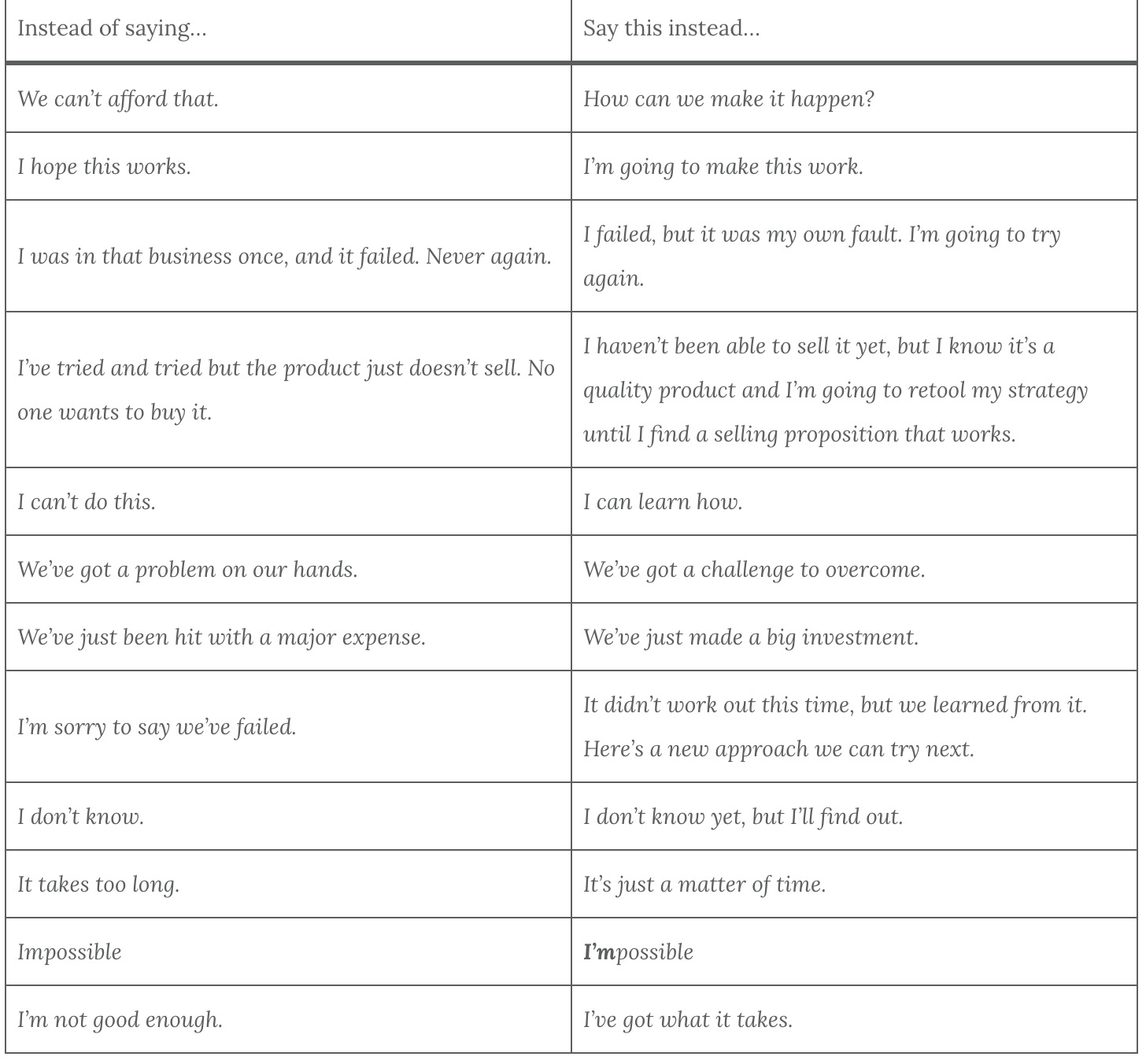
Using the vocabulary of a big thinker doesn’t require a big vocabulary.
The only thing it requires is that you be aware of the effect your words have on your mind—and to adjust accordingly.
Actionable insights
Start using a big thinker’s vocabulary. Use big, bright, cheerful words. Use words that help you and others envision victory, happiness, optimism and pleasure. And avoid language that evokes failure, defeat, pessimism, and negativity.
Be mindful of your language. When you’re chatting with others, be mindful of the words and phrases you use. If you catch yourself using disempowering phrases, look for ways to rephrase them into empowering ones:
Turn “I can’t” into “I’ll figure it out.”
Turn “This is impossible” into “I’m sure there’s another way.”
Turn “I don’t know” into “I don’t know yet—but I can find out.”
When you strengthen your language, you’ll strengthen your mindset.
— Dean Bokhari
Co-founder, Gents Journey
Share this with a friend who could use it.
📰 THE MOMENT
Sh*t that’s happening now, ICYMI
↓
This Week’s AI Prompt: Watch Your Language
Your words are the paintbrush. Your brain is the canvas. What are you painting?
You don’t realize it, but you’re painting your reality with every word you speak.
Not just to other people. To yourself.
The language you use—both internal dialogue and external speech—literally shapes your brain. It creates the visuals that determine how you see yourself, your life, and your possibilities.
Small thinkers use language that shrinks. Big thinkers use language that expands. The difference isn’t their intelligence. It’s their vocabulary.
This prompt helps you audit the language you’re using and intentionally shift it so you’re painting something magnificent instead of something mediocre.
THE PROMPT:
Copy everything below and paste it into ChatGPT or Claude:
I want to become aware of my language—both what I say out loud and what I say to myself—and shift it so it's creating the reality I actually want instead of limiting me.

Help me:

1. Audit my current language (The brutal truth)
   - What phrases do I say to myself repeatedly? (When I mess up, when I'm scared, when things are hard)
   - What do I say out loud to others about my life, my goals, my abilities?
   - Am I using shrinking language or expanding language?
   - Do my words close doors or open them?
   - What visuals am I painting with my words?

Examples of shrinking language:
   - "I can't..." / "I'm not good at..." / "That's not for me..."
   - "It's too hard..." / "I'm too old..." / "I don't have time..."
   - "That probably won't work..." / "I always mess this up..."
   - "I'm just not talented enough..." / "People like me don't..."

2. Identify my specific shrinking patterns
   - What's the ONE phrase I say most often that's limiting me?
   - When do I say it? (When I'm scared? Tired? Facing something hard?)
   - What's the visual that phrase creates in my mind?
   - How has this phrase shaped my choices and my reality?

3. Reframe into expanding language
   - For each shrinking phrase, what's the expanding version?
   - Instead of "I can't," what could I say? ("I'm learning how to..." / "I haven't figured it out yet...")
   - Instead of "It's too hard," what could I say? ("It's challenging, and that's where I grow...")
   - Instead of "I'm not good at this," what could I say? ("I'm getting better every time I try...")
   - What visuals do these new phrases create?

4. Build awareness of my self-talk
   - What's my go-to negative phrase when things get hard?
   - What's my go-to limiting belief about myself?
   - How often do I say these things per day? (Be honest)
   - Who else am I influencing with this language? (Kids? Partner? Friends?)

5. Create a language practice (Make it real)
   - What's ONE shrinking phrase I'm going to eliminate this week?
   - What's the expanding replacement I'm going to use instead?
   - How will I catch myself when I slip back into the old language?
   - What's my reminder to choose different words?
   - How do I celebrate the days I use better language?

Here's my current self-talk: [Write out the phrases you say to yourself]

Here's what I say out loud about my life: [Describe your external language patterns]

Here's the reality I'm painting: [What's the result of this language?]

Don't let me minimize this. Words matter. Help me see how my language is creating my reality—and how changing it changes everything.
WHAT HAPPENS NEXT
The AI is going to show you exactly how your language is shaping your brain and your reality. It’s going to help you identify the shrinking phrases you use on repeat—and replace them with expanding ones.
By the end, you’ll have:
A clear audit of your current language (internal and external)
An understanding of the visuals your words are creating
Specific expanding phrases to replace shrinking ones
A practice to catch and shift your language in real time
Awareness of how this affects your life and everyone around you
WHY THIS MATTERS
Your mind is a canvas. Your mouth is the paintbrush. Your words are the paint.
Every word you say to yourself, every phrase you repeat, every story you tell about who you are—it’s all painting a picture. And that picture becomes your reality.
Small thinkers use language that closes doors. Big thinkers use language that opens them.
You don’t think differently because you are different. You are different because you think—and speak—differently.
Change your words. Change your visuals. Change your life.
Run this prompt. Audit your language. Start painting something magnificent.
Drop one shrinking phrase you’re committing to replace this week. Let’s see who chooses better words.
— Matt McManus
Co-founder, Gents Journey
Words Matter
👊 THE MOVES
Media for men.
↓
Watch | The ABC’s of CBT: Thoughts, Feelings, Behavior

In the video above, you’ll learn about the ABC Model of Cognitive Behavioral Therapy (CBT):
A = Activating Event
B = Belief (the story we tell ourselves)
C = Consequence (the feeling or behavior that follows)
Here’s a simple example:
Someone walks past you and doesn’t say hello.
The event is neutral.
But if your belief is, “They don’t like me,” the consequence might be anxiety, frustration, or sadness.
The challenge is that most of these beliefs happen automatically. We rarely stop to question them.
If we’re anxious, we tend to have anxious thoughts. If we’re sad, we tend to have sad thoughts.
That’s why mindfulness, journaling, meditation, and simply being present are so powerful. They create awareness.
Because once you notice the story, you can change it.
The Story We Tell Ourselves
The most important conversation you’ll ever have is the one happening inside your head. My mentor Pat Croce calls it “the movie of me.”
Your thoughts create meaning.
Your meaning creates feelings.
Your feelings influence your actions.
The good news? You can learn to interrupt the cycle.
Notice the voice in your head.
Notice the tension in your body.
Notice the stories you repeat over and over again.
Once you become aware of them, you can choose a different response rather than reacting automatically.
This applies to everything, from relationships and careers to the stories we write about our own lives.
In a world increasingly filled with AI-generated content, it’s more important than ever to connect with what is real: your experiences, your purpose, your relationships, and the moments that shaped you.
Here’s a question from our Journey Deck for you to comment on:
What’s the story you tell yourself about the man you are?

Creating Space to Find Meaning
Five years ago, I found myself overwhelmed.
I was raising a one-month-old baby.
Helping care for my mother.
My marriage was strained.
And I had lost all but one of my marketing clients at The Seidel Agency.
My thoughts sounded something like this:
“I don’t deserve this.”
“What did I do wrong?”
“I don’t have enough time.”
“Why is everything falling apart?”
I felt stuck.
But eventually, I realized it wasn’t just the activating events creating my suffering. It was the meaning I was assigning to them.
When I changed the story, I changed the outcome.
Instead of seeing myself as a victim, I started seeing myself as someone being called to grow.
That simple shift eventually led to the founding of Gents Journey.
And today, more than five years later, you’re reading our 21st newsletter.
All because I learned to create space between the event, the belief, and the consequence.
So here’s my challenge to you: What can you do to create more space between your A, B, and C so you can respond instead of react?
And if you’re ready to rewrite the story you’re telling yourself, join us for the Gents Journey Summer Book Club.
Let’s educate ourselves together to change our thoughts and beliefs, while creating our new reality.
Your next chapter begins today.
— Stephen Seidel
Co-founder, Gents Journey
🔗 MEANINGFUL MENTIONS + MAGIC LINKS
Fun stuff you’ll dig about our theme of the week.
↓

💻 REAL MEN HAVE A COACH IN THEIR CORNER
Stop playing small, step into the man you know you are.
_
We’re looking for ten men who want coaching and guidance to level up in life + work. If that’s you, fill out this form, and we’ll be in touch.
Until next week,
—The Gents
Inspired? Share this newsletter with another Gent you think it could help.
The Gents Weekly Podcast
The manliest podcast on the internet.

Listen & subscribe on
Substack | Apple Podcasts | Spotify